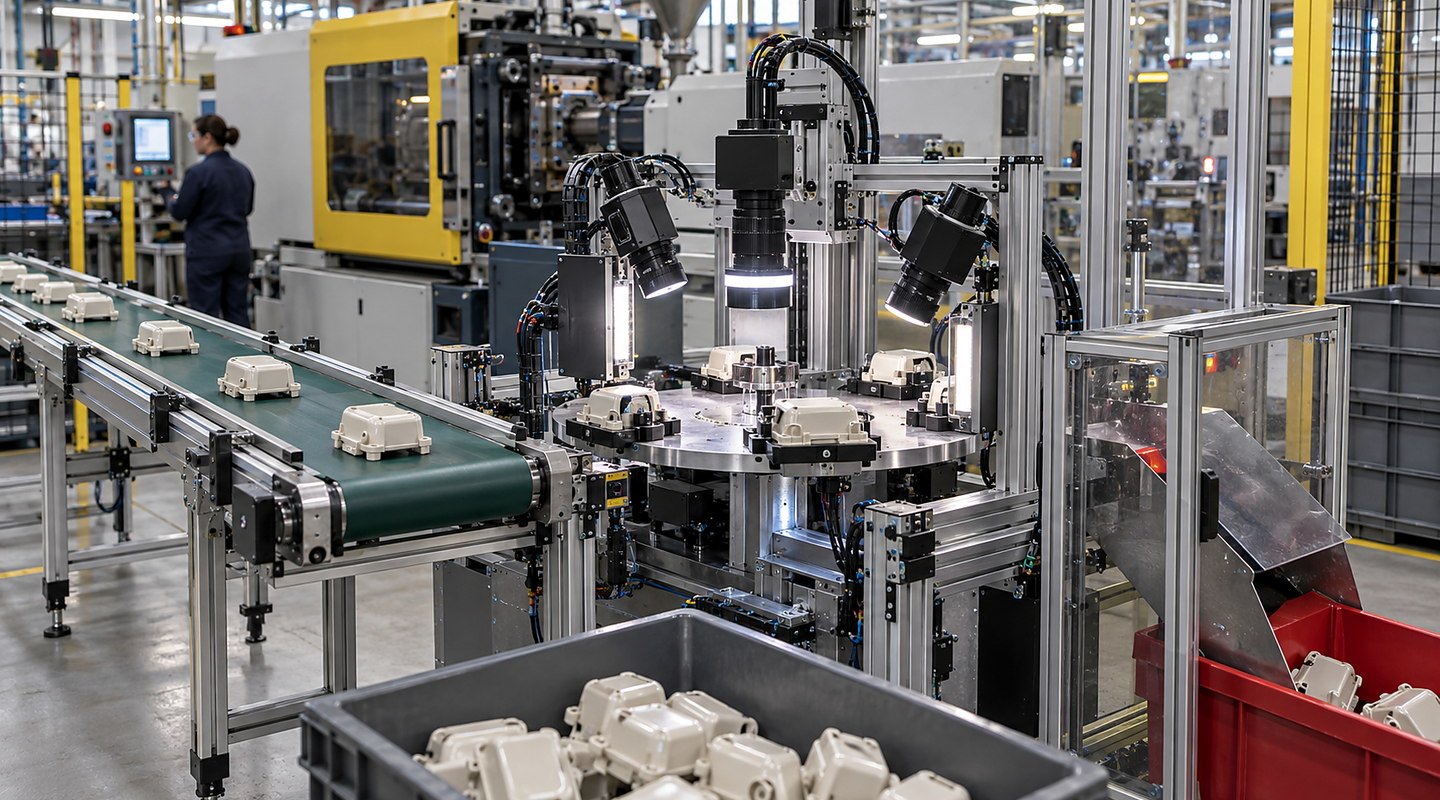
Extrusion Inspection Selection Guide
Choose extrusion inspection by comparing your parts, process, rate, access, data needs and required results.
Compare extrusion-inspection concepts against the same profile and visible-defect definition. Use borderline samples to establish what can be distinguished in an image and which properties require a separate check.
For in-line inspection using profile and surface inspection of extrusions, a short trial that reproduces the difficult condition is often more useful than a long list of nominal specifications.
Compare options in the conditions where they must work — Extrusion Inspection
Plan extrusion inspection around representative good, bad and marginal samples, line presentation, lighting, reject handling and challenge criteria. Discuss an optical feasibility trial with Oxford Vision Systems. A useful shortlist should show how every option copes with visible defect or measurement definition for profile & surface inspection of extrusions and recipe, reject and line-control interfaces.
Discuss your application

Ask every supplier the same questions
| Decision | What to ask | What to check |
|---|---|---|
| Visible Defect or Measurement Definition for Profile & Surface Inspection of Extrusions | What normal range, extreme and rate of change applies to visible defect or measurement definition for profile & surface inspection of extrusions? | Representative samples and a controlled trial. |
| Good, Bad and Marginal Sample Range | What normal range, extreme and rate of change applies to good, bad and marginal sample range? | Representative samples and a controlled trial. |
| Part Presentation and Production Speed | What normal range, extreme and rate of change applies to part presentation and production speed? | Drawings, observation and interface measurements. |
| Optics, Lighting and Environmental Conditions | What normal range, extreme and rate of change applies to optics, lighting and environmental conditions? | Drawings, observation and interface measurements. |
| Recipe, Reject and Line-Control Interfaces | What normal range, extreme and rate of change applies to recipe, reject and line-control interfaces? | Agreed operating and acceptance records. |
| False-Accept, False-Reject and Challenge Criteria | What normal range, extreme and rate of change applies to false-accept, false-reject and challenge criteria? | Agreed operating and acceptance records. |
Include simpler approaches to profile and surface inspection of extrusions in your shortlist
| Approach | Often suitable when | Watch for |
|---|---|---|
| Extrusion Inspection | You need a dedicated solution for a clearly defined duty, product or part range and line interface. | A camera can only assess a property made visible and repeatable by the inspection setup. |
| Purpose-Built Sensors for Simple Presence or Position Checks | Your volumes, product mix or operator judgement make a simpler route more practical. | Check ergonomics, consistency and safe access before choosing the lower-complexity option. |
| Offline Metrology or Destructive Tests where the Property Is Not Visible Inline | Your surrounding process is stable enough for a broader automated solution to add value. | Allow for line connections, fault recovery and maintenance as well as the headline equipment. |
Pause before choosing when…
- Only perfect or hand-selected examples of in-line inspection using profile and surface inspection of extrusions are available.
- No one has defined how false-accept, false-reject and challenge criteria will be evaluated.
- The normal range for visible defect or measurement definition for profile & surface inspection of extrusions is described only as “usually fine” but has not been bounded.
- Your operator, cleaning, maintenance or recovery access has not been considered.
- Quoted performance depends on another machine or data source that is not included.